I’m often surprised by how little many women know about their pelvic floor muscles.
Maybe I shouldn’t be! There are good reasons why these muscles aren’t as well understood as others.
First, you can’t actually see them!
This is one of the biggest challenges to knowing if we are correctly performing a pelvic floor muscle contraction.
With muscles like your arms or legs, you can easily watch them move, which helps you understand how they work. Unfortunately, without some help it’s not possible to see your pelvic floor muscles contracting and relaxing.
Another issue is that many women don’t even know what these muscles are or what they do.
I find that it’s easier to improve how I use these muscles when I can picture them in my mind, even if I can’t see them.
To help with that visualisation, it’s useful to have a simple understanding of the anatomy involved.
If you’re unsure about the pelvic floor anatomy, don’t worry! You can check out my article on the pelvic floor for more information.
Let’s start with clearing up a few misunderstandings about pelvic floor muscle exercises …
These are NOT pelvic floor exercises!
Here are some examples of exercises that people have thought are for the pelvic floor.
I’m sharing these not to make anyone feel bad, but to show that if you’ve been doing something like this and weren’t sure what a pelvic floor exercise actually is, you’re not alone.
These are not designed to be pelvic floor exercises.
- A pelvic tilt (rocking the pelvis forward and back)
- A bridge (lying on your back, rolling your pelvis and then back off of the ground)
- Bringing your legs in and out to the side
- Squeezing your bottom
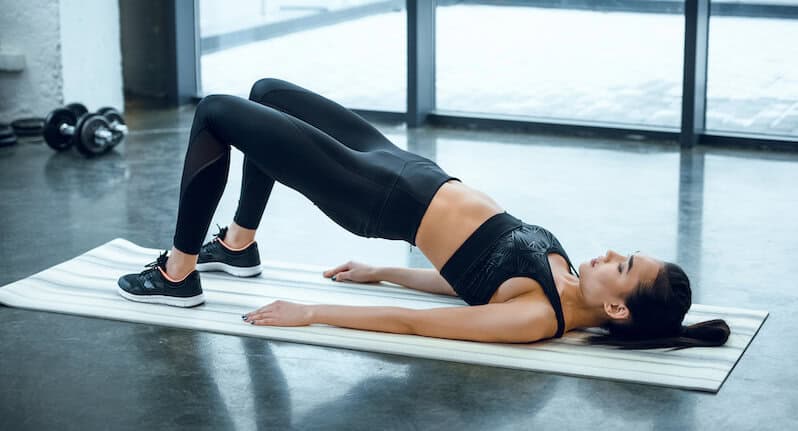
These exercises have their purposes, but improving pelvic floor strength isn’t one of them.
So if these exercises don’t do the job, let’s learn about correct pelvic floor exercises.
A good starting place is knowing where the pelvic floor muscles are, what they do, then how to exercise them.
Following is a quick primer on the pelvic floor muscles, but it worth reading this more comprehensive description about the structure and function of the pelvic floor.
A primer on the pelvic floor muscles
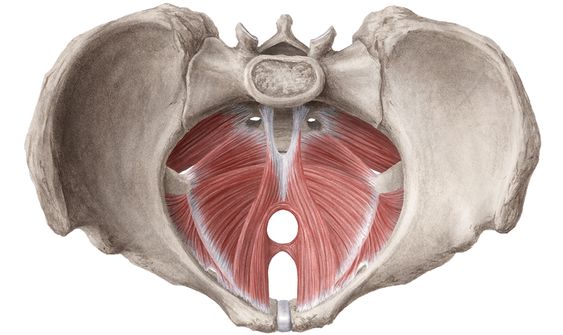
The pelvic floor muscles are a group of muscles that make up the bottom part of the pelvis.
They stretch from the front of the pelvis (the pubic bone) to the back (the tailbone, or coccyx).
These muscles help support the organs in the pelvis, which takes some pressure off the surrounding tissues. Think of them like a supportive hammock for your internal organs. When these muscles are functioning well, they automatically help you control your bladder and bowels.
Additionally, they support the vaginal wall, which can enhance pleasure during sex.
There are two layers of pelvic floor muscles:
- Deep pelvic floor layer These muscles lift and support the pelvic organs and help maintain the angle at the back where the rectum connects. This layer includes muscles like the levator ani and coccygeus.
- Superficial pelvic floor layer These muscles help close off the openings of the vagina and anus. The muscles at the front help close around the urethra and vagina, while at the back, the external anal sphincter surrounds the anus, which is important for controlling bowel movements.
An important point about doing a pelvic muscle contraction
It is important to emphasise that your pelvic floor muscles do not include your bottom (gluteals), stomach (abdominals) or your thighs (hip adductors, hip flexors, quads or hamstrings).
That means when you are doing quality pelvic floor exercises it should be ISOLATED to your pelvic floor muscles.
No other muscles should be engaging.
You shouldn’t be using or noticing any other muscles while doing these exercises.
If you’re doing them correctly, no one around you should even notice.
The correct way to do pelvic floor exercises
It’s important to do these exercises well, so you need to concentrate when doing them.
Focus!
- squeeze the muscles around your back passage, as though you’re trying to stop wind
- while holding this, squeeze the muscles around the entrance to the vagina
- while squeezing both the front and back passage, lift the muscles (as though you are trying to lift your perineum away from your underwear.
The whole action should feel like a squeeze and lift inside
After each squeeze and lift, make sure you fully relax your muscles back to their starting level.
You should be able to feel a sensation of ‘letting go’. If you can’t feel the contrast between ‘on’ and ‘letting go’, you have likely already fatigued the muscles.
The 3 types of pelvic muscle training
- Slow exercises – strong, long holds. We want to build endurance to maintain a pelvic floor muscle contraction for 10 seconds, 10 times in a row (with at least a 10 second break between
- Quick exercises – a short 1 second squeeze followed by 1 second relaxation, 10 times in a row
- ‘The knack’– this is a conscious effort to do a strong squeeze and lift hold prior to activity can cause issues with incontinence such as coughing, sneezing or lifting heavy weight.

What if you aren’t sure about it?
Without some type of feedback, most women don’t know or aren’t certain how to do the exercise – and it isn’t hard to understand why!
If you are not confident that you are correctly engaging your pelvic floor muscles, it is in your best interests to see a Women’s Health Physiotherapist who can guide you.
It doesn’t have to be as invasive as you might think!
For example, using Real Time Ultrasound means we are able to assess how well someone can contract and relax their pelvic floor muscles via the tummy.
No undressing is required.
Read more about what to expect during an initial womens health physio consultation.
Not sure if you are doing pelvic floor exercises correctly’?
Call 8356 1000 and speak confidentially with our women’s health physiotherapist Lisa Vernon.
This service is FREE OF CHARGE – we understand that it can be overwhelming to seek help for pelvic issues.
Lisa is sensitive, tactful and always happy to discuss how improving your pelvic health can enhance your life, and the options that physiotherapy can provide.
Call 8356 1000 to organise a FREE PHYSIO PHONE CALL or BOOK ONLINE at the top of the page.