Basketball injury prevention matters if you play regularly, because an ankle sprain or stubborn knee pain can feel like it is always waiting around the corner.
You want to train hard, improve, and stay on court. You also want to move confidently, without hesitating every time you jump, land, or change direction.
The good news is that basketball injury prevention is not about playing cautiously or holding back.
It is about building the strength, control, and preparation that let you play freely.
When issues keep coming back, getting them checked early often saves weeks of frustration later.
This article explains why basketball players get ankle and knee injuries, how to prevent them with warm-ups and strength training, and when to seek professional help.
If you’re in Adelaide and ankle sprains or knee pain keep coming back, we can help you work out what’s driving it and map out a clear plan. Book online, or call to chat with one of our physios free of charge.
- a structured warm-up
- strong lower limbs
- sensible training loads
For recurring ankle sprains, the evidence supports balance training and bracing to reduce sprain risk (Bellows & Wong, Sports Health, 2018).
For front-of-knee pain linked to jumping, progressive loading helps, and heavy slow strength work is a key tool (Li et al., Heliyon, 2024).
Parents: if there was a pop, a hard fall, rapid swelling, or the joint feels unstable, book in early (Frobell et al., New England Journal of Medicine, 2010).
Basketball demands on your body
Basketball places very specific demands on your legs.
In training and during a game, you repeatedly:
- Jump and land
- Stop quickly (decelerate)
- Cut and pivot
- Absorb contact
These actions load the ankles, knees, hips, calves, and tendons.
Fatigue plays a big role.
Late in games or tournaments, landings tend to get heavier, knees stiffen, and movement control drops. That is often when awkward injuries happen.
For taller high school players, this challenge can be even greater.
Longer limbs act like longer levers, making it harder to control hip and knee position quickly, especially during growth spurts.
This is one reason strength and movement control are so important.
Common basketball injuries and their causes
Ankle sprains
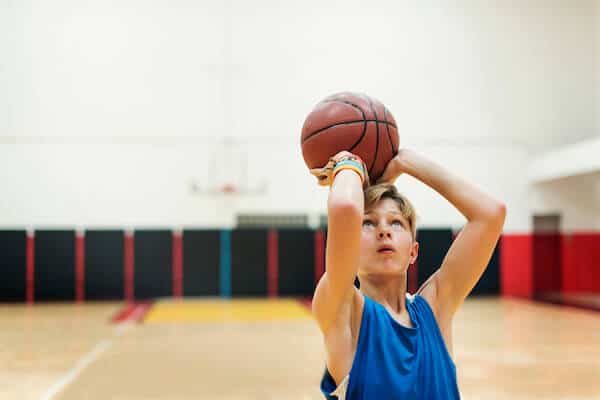
Most ankle sprains are lateral ankle sprains and happen during a landing, often when another player’s foot is under the hoop, or during a fast cut.
When sprains keep recurring, it is usually not because the ligament “never healed”.
More often, balance, coordination, and reactive control did not fully return.
That leaves the ankle more likely to roll again when speed and fatigue are added (Bellows & Wong, Sports Health, 2018).
Front-of-knee pain and “jumper’s knee” patterns
Much of the knee pain seen in basketball is related to load.
- Jumping volume increases.
- Gym work becomes inconsistent.
- Leg strength does not keep up with court demands.
This can irritate the patellar tendon or the front of the knee, leading to ‘jumper’s knee’, another name for patellar tendinopathy or patellofemoral pain.
The answer is rarely “rest forever”. In most cases, the solution is to gradually build capacity and manage load more effectively (Li et al., Heliyon, 2024).
Muscle strains (calf, hamstring, quad)
The rapid starts and stops in basketball can stress muscles like the calves, quads and hamstrings.
Poor warm-ups, fatigue, and sudden spikes in sprinting or training intensity all increase the risk of muscle strains.
Got Questions? Speak to a PHYSIO FREE
Got a basketball injury that just won’t go away? Always rolling your ankle?
Book a 15-minute phone call with Howard – no strings attached.
Call 8356 1000 to organise a FREE ‘ASK A PHYSIO’ PHONE CALL today!
Five mistakes that increase injury risk
- No structured warm-up. Training itself is not a warm-up.
- Stretching only, with little focus on strength or control.
- Lack of strength and conditioning. You cannot “skill” your way around weak legs.
- A bodybuilding-style gym routine. Lots of upper body work, light legs, and chasing a pump instead of building usable strength for basketball.
- Prioritising playing time over everything. Playing through pain that changes movement, rushing back after sprains, or stacking extra sessions without recovery.
A simple rule helps here: performance improves when your body can tolerate the sport.
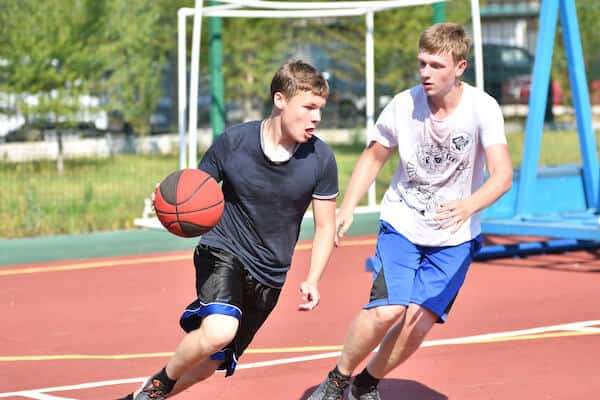
Warm-up strategies for injury prevention
If you want the simplest, research-backed approach to a warm-up that supports basketball injury prevention, this is it.
Use the FIFA 11+ warm-up, and use it consistently.
Many people assume FIFA 11+ is only for soccer.
However, a cluster randomised controlled trial in elite male basketball players showed that using FIFA 11+ as the warm-up across a season reduced overall injuries, training injuries, lower-limb injuries, acute injuries, and severe injuries (Longo et al., American Journal of Sports Medicine, 2012).

How to use it
- Do the full FIFA 11+ before training and games.
- Consistency matters more than doing it perfectly once.
- Treat it like brushing your teeth. It is non-negotiable if you want fewer setbacks.
Once you’ve nailed a warm-up that prepares your body, the next step is building the strength and control that help you absorb forces and stay resilient on court.
Lower limb strength training for basketball injury prevention
If you want fewer ankle sprains and less knee pain, strong legs are essential.
This is where basketball-specific strength training outperforms a generic gym plan. You want strength that helps you:
- Absorb landing forces
- Control knee position
- Stop and cut without collapsing
- Tolerate higher training loads
At Adelaide West Physio + Headache Clinic, we often see athletes benefit from targeted strength sessions designed around their game schedule.
Go heavy, go slow (strength focus, not bodybuilding)
In clinic, I see a lot of junior and high school basketballers fall into bodybuilder-style programs they find online. It’s usually heaps of arms and “pump” work, with not much that carries over to jumping, landing, and stopping.
With basketball, I’m not chasing muscle size for its own sake. I’m chasing usable strength and control. That’s why I like heavy slow resistance (HSR). It’s a simple way to build real lower-limb capacity, and it’s commonly used in progressive loading plans for tendon and knee pain (Li et al., Heliyon, 2024).
When you lift heavy and slow, you’re not only giving your tendons a strong training signal. You’re also building genuine strength that can help you move better and feel more solid on court.
Above is a video of me demonstrating a HSR squat, note that I am aiming for 4 seconds on the way up and 4 seconds on the way down.
Where isometrics fit for sore knees
In clinic, I often use isometrics as a “bridge” when someone’s patellar tendon is cranky but they still need to train through the season. Isometric contractions can reduce patellar tendon pain in the short term, which can make training feel more do-able (Rio et al., British Journal of Sports Medicine, 2015).
I’m careful not to oversell them. Isometrics are not the whole solution. I use them as a tool to help you keep moving while we build your longer-term strength and tendon capacity.
One of my go-to options is a max-effort isometric lunge. I set up in a split stance, wedge a barbell into the rack, then pull as hard as I can through the bar while driving into the rack so nothing actually moves. I’ll often lift my heels slightly so the calf and Achilles get a bit of loading as well.
In the video below, I’m demonstrating the isometric lunge setup and effort.
The lower limb priorities (what matters most)
Focus on building:
- Quadriceps and glute strength (squats, split squats, step-ups)
- Calf strength, with both straight-knee and bent-knee raises
- Hip control through single-leg strength patterns, including adductors and abductors
- Trunk control, which supports better lower limb alignment and movement quality
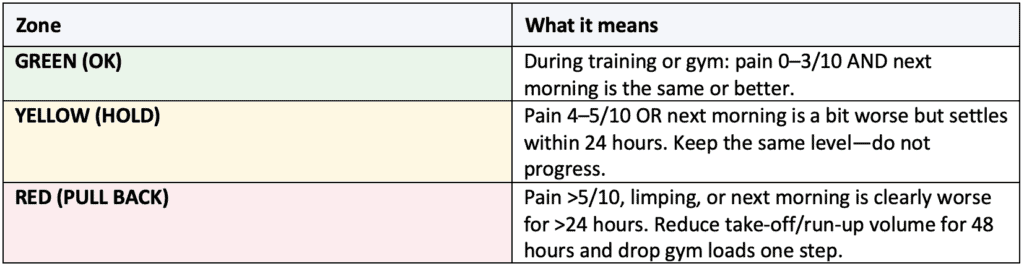
A simple weekly target (in-season)
- Two lower-limb strength sessions per week
- Controlled tempo throughout each movement, going heavy and slow
- Adequate rest between sets
- Stop sets before technique deteriorates
Parents
If your child is unsure what to train in the gym, they often default to what they see online.
That usually means bicep curls, bench press, and lots of upper-body work.
These exercises do little to protect ankles and knees.
Preventing basketball injuries comes mainly from stronger legs, better single-leg control, and improved landing and stopping strength.
Landing mechanics that protect knees
Landing form matters for every basketballer, but I pay extra attention to it in taller players.
Longer limbs are harder to control at speed, especially during growth spurts, so small faults can get “locked in” if they are never picked up.
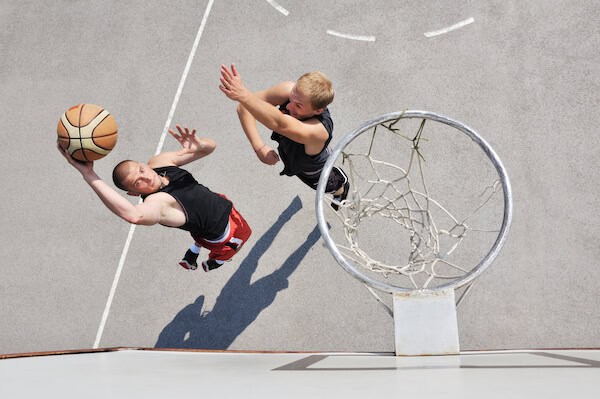
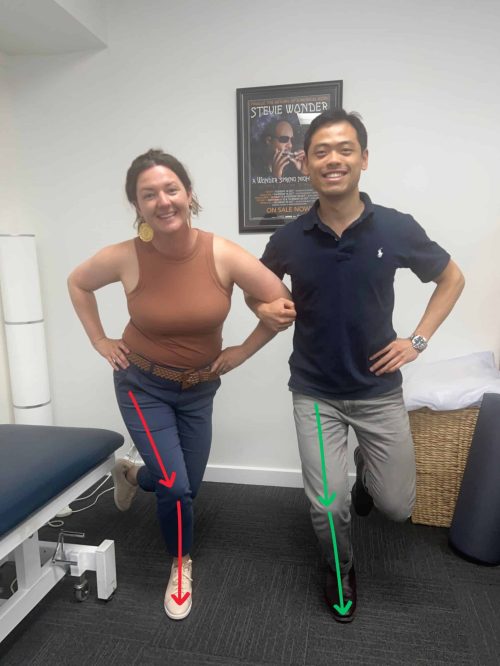
When the knee collapses inward on landing (often called knee valgus), it can increase stress around the front and inner side of the knee.
This movement pattern is also commonly seen in non-contact ACL injury situations, particularly when athletes are fatigued.
In the photo, Lisa is on the left showing knee valgus, and I’m on the right showing good alignment.
Notice how Lisa’s knee drops inward. On my side, the knee stays stacked and tracks over the foot, with the hip and trunk supporting the position.
Key cues I coach are:
- Land quietly
- Keep the knees soft
- Sit the hips back slightly
- Keep the knees tracking over the middle toes
- Control the descent instead of collapsing into it.
The taller the player, the more important it is to build enough leg strength and trunk control to hold those positions under speed and fatigue.
This is not about posture. It’s about capacity.
You need enough strength and control to manage longer levers when the game gets fast.
In my experience, a lot of tall players have some valgus on jumping and landing for years and no one has ever pointed it out.
The longer it goes on, the harder it can be to retrain. That’s why I like to address it early, especially while someone is going through a growth spurt.
If you want the best “bang for buck” area to train for knee control, I usually start with the hip abductors, because they help control thigh position and reduce that inward collapse.
Preventing repeat ankle sprains
If you’ve rolled your ankle before, an ankle brace can be a really useful safety net, especially in fast, unpredictable game situations.
The research supports both bracing and balance training to reduce ankle sprain risk.
It also suggests bracing does not worsen proprioception in people with recurrent sprains or functional ankle instability.
That said, I still tell players not to rely on the brace as the only solution. Long-term stability comes from retraining balance, coordination, and fast reactions.
Some studies also show braces can change muscle activation around the ankle, which is another reason I like most rehab and gym work done without a brace.
From my time working as a physio in NBL1, I saw plenty of players who wore a brace every single game, even when they didn’t have an acute ankle injury.
Most of them would train without a brace, but they would always strap up on game day. Whether it was superstition, confidence, or just comfort, I’m not sure.
But the key point is this. If a brace helps you feel stable and play with confidence, it can be a perfectly reasonable choice.
Even Steph Curry is known for wearing ankle support, so don’t feel like you have to play brace-free to be “doing rehab properly”.
A simple way to combine support and independence
Games and high-risk sessions: wear the brace, especially early after returning or if you have a history of repeat sprains.
Gym and rehab sessions: perform most balance work, calf strengthening, and single-leg control exercises without the brace.
Wean gradually: first remove the brace for low-risk training, such as shooting or controlled drills. Keep it for games until hopping, landing, and cutting feel confident and stable.
Training load and injury risk
Training load matters more than most people think
A large part of injury prevention is avoiding sudden spikes in load, such as:
- Extra team sessions
- Weekend tournaments
- School sport combined with club training and gym work in the same week
Before training, a simple check can help:
- Do my legs feel unusually heavy today?
- Is pain changing how I run, jump, or land?
- Am I taking longer than usual to recover from my last session?
If the answer is yes, keep the warm-up, reduce intensity for that session, and protect the week rather than forcing one hard day.
When to see a physio in Adelaide
Book early after a “bad” injury
- You heard or felt a pop or bang
- You fell hard and could not continue playing
- There is rapid swelling, bruising, or difficulty weight-bearing after an ankle sprain
- The knee or ankle feels unstable or unreliable
Also book if
- Pain lasts longer than two to three weeks
- Pain is changing technique, such as limping or avoiding jumps
- Ankle sprains keep recurring
- Knee pain worsens with jumping and does not settle
- Injuries persist from season to season
Why professional guidance helps
Understanding the theory is helpful, but getting guidance is often faster.
A physio can assess what is driving the issue and build a plan tailored to the individual, their training load, and their goals.
This usually includes clear strength targets, appropriate use of isometrics when needed, and a structured return to jumping and cutting.
Frequently Asked Questions
Should I wear an ankle brace?
Bracing can reduce ankle sprain risk, particularly if you have sprained your ankle before (Bellows & Wong, Sports Health, 2018).
It is still important to train without a brace at times to develop balance and coordination.
Do I need a scan for knee pain?
Not always. Obvious signs such as a pop, significant swelling, locking, or instability should be assessed early.
Otherwise, a thorough clinical assessment and a structured plan are often the best first step.
Is surgery always the first option for ACL injuries?
ACL decisions are individual. What is consistent is that high-quality rehabilitation is essential.
In young active adults, a rehab-first approach with the option of delayed reconstruction was not inferior to early surgery in the KANON trial (Frobell et al., New England Journal of Medicine, 2010).
For juniors and high school players, this decision should always involve a Physio.
Next steps to stay on court
If you want to improve performance and reduce setbacks, keep it simple:
- Nail the warm-up every session
- Prioritise lower-limb strength twice per week
- Keep landing mechanics clean, especially when tired
- Avoid sudden spikes in training load
If you are in Adelaide and ankle sprains or knee pain are holding you back, we can help you put a clear plan in place.
Book online now, or call us to organise a time to talk with one of our physios free of charge.
Talk to a Physio FREE Today!*

References
Al Attar WSA et al. Effectiveness of FIFA injury prevention programs in soccer: a meta-analysis of meta-analyses. Scandinavian Journal of Medicine & Science in Sports. 2019. (PubMed)
Bellows R, Wong CK. The effect of bracing and balance training on ankle sprain incidence among athletes: a systematic review with meta-analysis. Sports Health. 2018. (PMC)
FIFA Medical Network. The “11+” complete warm-up programme. 11+ Workbook. 2011. (Dr. Bu Balalla)
Frobell RB et al. A randomized trial of treatment for acute anterior cruciate ligament tears. New England Journal of Medicine. 2010. (New England Journal of Medicine)
Li Y et al. Mixed comparison of eccentric, isometric and heavy slow resistance for patellar tendinopathy: systematic review and network meta-analysis. Heliyon. 2024. (Cell)
Rio E et al. Isometric exercise induces analgesia and reduces inhibition in patellar tendinopathy. British Journal of Sports Medicine. 2015. (British Journal of Sports Medicine)