
We assess whether your upper neck may be contributing to your headaches or migraines.
One-hour headache assessments in Fulham. No GP referral needed.
Perhaps you’ve spoken with your GP, tried medication or waited months to see a specialist, yet still feel unsure about why your headaches keep happening or what else you can do.
Meanwhile, episodes keep interrupting work, family time and plans.
Other people can’t see what you’re experiencing, so they can’t understand why you can’t simply push through.
You may also worry that something serious has been missed.
Our headache physios give you time to explain the full story.
We screen for anything that needs medical investigation and use the Watson Headache® Approach to assess whether your upper neck may be contributing.
Who this service is for
This may be suitable if:
Most recurring headaches and migraines are not medical emergencies. However, a sudden, severe or very different headache needs prompt medical attention.
The Watson Headache® Approach is a systematic method to assess and treat the upper neck and its contribution to headache, migraine and related conditions.
It starts with understanding your headache or migraine history and working out baseline measures so we know exactly how much we are affecting your symptoms.
Importantly, we check for any signs that indicate a need for further medical investigation.
We then carefully examine your upper neck for relevance. Treatment uses gentle, sustained pressure targeting relevant structures.
There is no neck cracking or high-velocity manipulation.
A focussed assessment that gets to the point.
Rather than assuming your headaches are related to your neck, we assess whether it may be contributing and whether treatment is worth pursuing.
Our aim is to give you a clear answer early on about whether we think we are likely to help or not.
Russell Mackenzie and Lachlan Sutherland have both completed the full training pathway and certification assessment with the Watson Headache Institute.
Nerves from the upper neck merge with a region of the nervous system that also receives signals from the head and face.
This shared region is called the trigeminocervical complex.
This provides an explanation for how the neck can be involved in all categories of headache and migraine involving pain anywhere in the head, including the temples, behind the eyes, sinuses, ear and jaw.
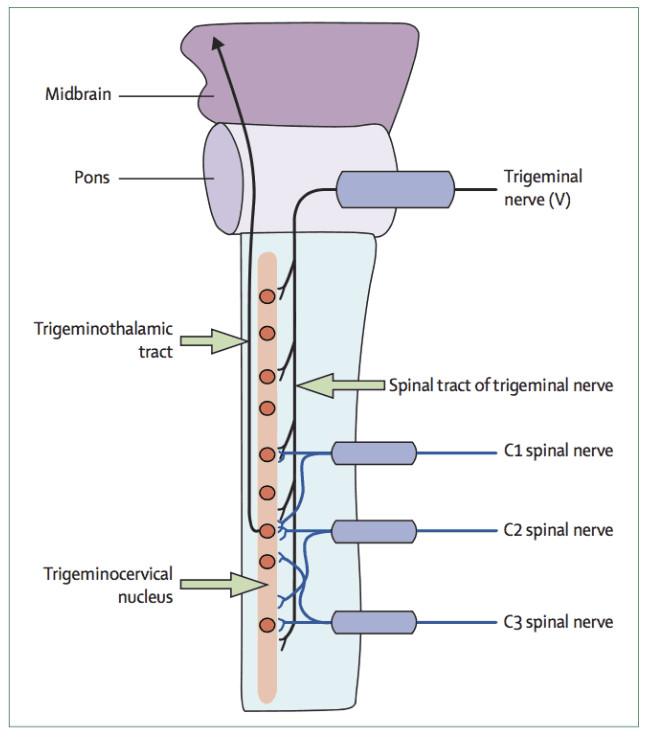
01
We discuss your headache or migraine pattern, associated symptoms, previous investigations, medication, treatment and how the episodes affect your life.
02
After appropriate safety screening, we use the Watson Headache Approach® to assess whether your upper neck may be contributing.
03
We talk you through the findings in plain language. If your neck appears relevant, we’ll discuss the treatment options.
Ready to talk to us?
Your initial appointment lasts one hour, giving time to work through your situation without feeling rushed.
Bring any relevant scan reports, specialist letters and a list of your medications if you have them.
Your physio will ask about your headache pattern, associated symptoms, previous care and general health before examining your neck.
The hands-on assessment uses slow and gentle pressure. We explain what we are doing as we go, and you can pause or stop at any time.
Treatment may begin during the first appointment if it appears appropriate and you are comfortable to proceed.
By the end of the appointment, we aim for you to understand:
If the assessment suggests that your upper neck may be contributing, treatment can begin using the same gentle, sustained techniques from the Watson Headache® Approach assessment.
We check how your symptoms respond during treatment and between appointments.
This helps us decide what to treat, how to progress and whether the approach is helping.
We review your progress and adjust the plan based on changes in your headache or migraine pattern, associated symptoms and everyday function.
Our aim is to make early meaningful progress that makes it clear that you are benefiting from the treatment approach.
If you aren’t making progress, we’ll reassess our approach, what may be limiting progress and discuss whether a different approach or health professional should be involved.
Want to understand the method in more detail?
Russell Mackenzie and Lachlan Sutherland are both Watson Headache® Certified Practitioners.

Russell graduated from UniSA in 1994 and co-founded Adelaide West Physio + Headache Clinic in 2009. He became a Watson Headache® Certified Practitioner in February 2014 and now works exclusively with headache and migraine patients.

Lachy graduated from UniSA in 2016 and joined Adelaide West Physio + Headache Clinic in 2021. He is a Watson Headache® Certified Practitioner, and headache and migraine care forms a major part of his clinical workload.
Book a one-hour headache assessment with Russell or Lachy at 506 Henley Beach Road, Fulham.
We’ll listen to your full story, assess whether your upper neck appears relevant and explain the most appropriate next step.
It may help when the upper neck is a meaningful contributor to the headache or migraine pattern.
The first step is assessment. We use the Watson Headache® Approach to explore whether your neck appears relevant before recommending treatment.
Physiotherapy won’t be the answer for everyone, and we’ll be up front if it doesn’t appear suitable for you.
We start with a detailed discussion about your headaches, associated symptoms and medical history.
After appropriate safety screening, we carefully assess individual areas of your upper neck using slow, sustained pressure.
We observe whether this produces a recognisable response in your usual symptoms and how that response changes during the assessment.
No single finding is considered in isolation. We explain what we conclude from the overall assessment.
Not necessarily. Some people with headache or migraine have obvious neck pain or stiffness, while others don’t.
That is why we need to manually assess the neck rather than relying just on the presence or absence of neck pain.
No. You can book directly with one of our headache physiotherapists.
If there is any suggestion that medical assessment is needed, we’ll explain why and what to do next.
It depends on what the assessment shows and how you respond to treatment.
The length of your symptoms isn’t necessarily an indication of how much help you might need.
We continually review your progress rather than recommending an open-ended course of care.
Our aim is to get you self-sufficient as quickly as possible.
We’ll tell you. We won’t recommend ongoing neck treatment if the assessment doesn’t support it.
We’ll explain what we found and discuss whether medical review, vestibular assessment or another type of care may be a more appropriate next step.
Depending on your presentation, assessing your neck might be the best starting point.
We also have a concussion physiotherapy service which deals specifically with the effects of concussion.
If you are unsure where to start, a free phone call with one of the physios can help clarify the right path for you.
If you suffer from headaches or migraines, this is the information that you must read so that you can be doing all the right things to help yourself.
This is the same information that we provide to our private patients, everything from practical posture advice to what you need to know about your pillow.
Did you know that regular use of pain relief medication can worsen your headaches?
Read this practical guide and take positive steps to help your headaches and migraines.