
Experience Life Fully - Regain Control
… you’ve probably asked yourself “why does it still hurt?”
Maybe you’ve had scans, tests, treatments, and medications, but nothing seems to shift.
You might have seen doctors or therapists who make you feel like your pain is ‘all in your head’?
Or perhaps you feel like you’re running out of options. Or patience.
If that sounds familiar, you’re not alone.
And you don’t have to keep guessing what to do next.
Because life’s too short to sit out on the things you love.
Prefer to talk first? Call 8356 1000 for a no-obligation chat.
... then move forward with confidence.
At Adelaide West Physio + Headache Clinic, we understand how exhausting long-term pain can be — physically, mentally and emotionally.
Our team provides persistent pain physiotherapy in Adelaide, helping people regain confidence and control through evidence-based care.
We’ve worked with hundreds of Adelaide people who have felt dismissed, frustrated, or stuck on medications that don’t seem to help.
You deserve care that treats you like a person, not a problem.Our physios combine up-to-date pain science with a genuine, human approach to help you:
Not sure what you need yet?
Let’s chat about your unique situation.
Since 2009, we have guided hundreds of patients with compassion towards less pain and a fuller life.
Our understanding comes from experience plus thousands of hours of professional development, reading and courses.
The truth is that the best approach to helping persistent pain is very different to helping acute problems.
In fact, if the same treatment approaches are used for chronic pain, there is a good chance they will not help at all, resulting in more frustration and pain.
You might have already found out that without the right approach, persistent pain can keep you stuck in the same loop – more tests, more medication but no answers.
That’s why our approach to chronic pain physiotherapy in Adelaide looks a little different.
Our methods draw on non-surgical pain management strategies and modern neuroscience — designed to help you move, think, and feel better.
Book a free no-obligation chat with a physio to talk through your situation.
Or call 8356 1000.

Since 2009, we have guided hundreds of patients with compassion towards less pain and a fuller life.
Our understanding comes from experience plus thousands of hours of professional development, reading and courses.
The truth is that the best approach to helping persistent pain is very different to helping acute problems.
In fact, if the same treatment approaches are used for chronic pain, there is a good chance they will not help at all, resulting in more frustration and pain.
You might have already found out that without the right approach, persistent pain can keep you stuck in the same loop – more tests, more medication but no answers.
That’s why our approach to chronic pain physiotherapy in Adelaide looks a little different.
Our methods draw on non-surgical pain management strategies and modern neuroscience — designed to help you move, think, and feel better.
Book a free no-obligation chat with a physio to talk through your situation.
Or call 8356 1000
Here’s what working with us looks like:
We start by understanding your story, not just your scan results.
Together, we set clear, achievable goals that actually make sense for you.
We use evidence-based strategies to help your systems work better together.
Chronic Pain Physio – Who Do We Help?
Wondering if this fits your situation? Call us on 8356 1000 and we can talk it through
If you would like to feel ...
Imagine feeling confident again when you move – understanding your pain and knowing that it is no longer calls the shots.
Our experienced Adelaide physiotherapists specialise in chronic and persistent pain physiotherapy, offering personalised, evidence-based support every step of the way.
Prefer to talk? Call 8356 1000
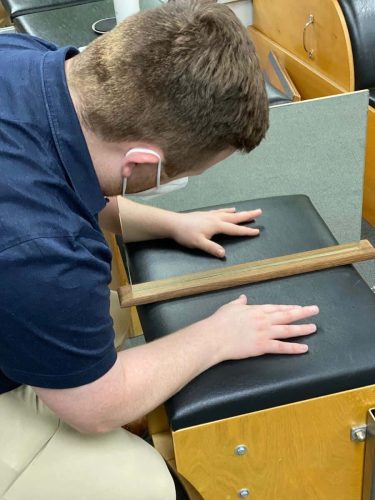
Getting ALL the relevant information about the problem, the timeline, investigations, current and past treatments..
Getting your own understanding of the problem and the reason why it still hurts.
2. Goal-setting and Planning
Goals are important to create and maintain forward movement. With you, we establish relevant, achievable goals with time frames.
Short term goals break a bigger goal into achievable 'chunks' and show that the longer term goals are possible.
With this process comes hope and enthusiasm for what can be achieved.
Treatment strategies will vary, but are not based on the 'passive therapies' that are used with other kinds of problems.
It will often include ways of helping to 'recalibrate' your body’s response to movement, load and challenges.
To create confidence to move, it is important to have a working understanding of the biology of pain.
There are other novel tools and strategies that can be used to target the central nervous system and pain processing.
OK, How do I get started?
To get started, the first step is booking your 60 minute initial assessment with one of our experienced physios.
This session is comprehensive in setting up the course of your treatment strategy by learning about you, your pain and your current limitations and goals.
We dig into more than just the ‘state of the tissues’!
It is important to come along with an open and curious mind. We might talk about things that are different to the kind of things that others have discussed in relation to your pain.
The educational component is always an important part of treatment. We understand that some of this information can be challenging at first, but we have found that if patients are open to taking on a new point of view on their pain, it is often the turning point.
We aim to deliver this in a way that is easy to understand, in a way that suits you and with the aim of keeping it relevant to your situation.
Got questions? Call us on 8356 1000 and let’s chat about your situation
Our approach to treatment is informed by years of experience working with people with persistent pain. We have learnt from courses, conferences, reading, involvement in research studies and direct contact with leaders in the field of persistent pain.
Many therapies treat the problem like an acute problem, looking for a ‘source’ for the pain. This kind of approach is often unsuccessful in helping people with persistent pain.
No. In fact, if ever you feel like we are saying it is all in your head, we have missed the mark and we hope that you would stop us.
Pain isn’t something that is ‘just’ in your head, or something that is in your brain. That is something that we aim to explain clearly.
Perhaps. It depends on the results of the assessment and what therapy you have tried before. If there is something in your assessment that suggests a reasonable target for manual therapy, that is something that might be explored.
However, there is no point going over old ground if you have tried manual therapy before without improvement. It may be worth going in a different direction.
If you have relevant results, they may be worth bringing with you. However, your assessment won’t hinge on these. We are more interested in hearing your story, what you have tried, and assessing you as you are.
If there are recent investigations that sound relevant, we can access them online.
When pain has been ongoing, education is often an important part of treatment.
The information you need is conveyed to give you better perspective why it still hurts, and what we can do about it.
Some people have been exposed to lots, some not much. Some people want to learn more, some are not keen to know about it. It is provided in a case by case basis.
There is no simple answer to that question, but there are reportedly 3.7 million people in Australia who live with persistent pain, or in other words 1 in 5 people and as high as 1 in 3 in the age group of 65 and older.
Although it is often assumed to be due to ongoing or unhealed ’tissue’ problems, the real reasons are always multifactorial – often with elements of biological, psychological, genetic, endocrine and immune elements.
This helps to understand why a solution that is only directed at ’tissues’ will often not be effective.
If you would like to dig a bit deeper (or you’re the kind of person who wants to understand why things work), here are a few plain English articles from our blog that might help:
What if your pain wasn’t about something being “broken,” but about your body doing its best to protect you? This article explains a practical, hopeful way to think about back pain — and why understanding it can change how you move:
Ever been told your nerves are “tight” or “irritated”? Here’s what that actually means (without the jargon), and how a skilled physio uses nerve testing to guide treatment.
We know that understanding pain better and taking away some of the fear has a direct effect on pain. This collection of nuggets are little bite-sized pieces of information that hopefully should be easy to digest. Just one at a time!
In your body, change is always going to happen. The good news is that the path of change isn’t predetermined. There are things that you can do always. This article should give hope to anyone who is struggling.
Pain doesn’t live in isolation. This post explores how life’s pressures — physical, emotional, and environmental — all add up and influence how our body feels.