If you’ve ever experienced persistent pain on the outside of your hip, especially when lying on your side, standing for long periods, or after walking, you may be dealing with a condition known as gluteal tendinopathy.
Gluteal tendinopathy is a common but often misunderstood cause of lateral hip pain.
It becomes even more confusing when different terms are used to describe the same condition!
This guide will walk you through what it is, why it happens and what can be done about it, drawing on the latest evidence and practical management strategies.
If you have hip pain, get in touch with us on 8356 1000 to speak with a physio free of charge* about how we can help you find relief and get back to your usual activities.
Quick Summary
Gluteal Tendinopathy
- Gluteal tendinopathy is a leading cause of lateral hip pain, especially in women aged 40–60. It’s often mislabelled as ‘hip bursitis’ despite tendinopathy being the primary pathology.
- Factors that increase compression on the gluteal tendon and the related bursae play a significant role in the development and persistence of symptoms.
- The condition is load-related, meaning it stems from the tendon’s inability to adapt to stress, often worsened by sustained compression or sudden increases in activity.
- Effective management does not involve rest alone – relevant education, activity modification, and progressive loading are the keys to recovery.
- Physiotherapy is effective in treating gluteal tendinopathy, offering a structured, evidence-based approach including load management, strengthening, and personalised rehabilitation plans.
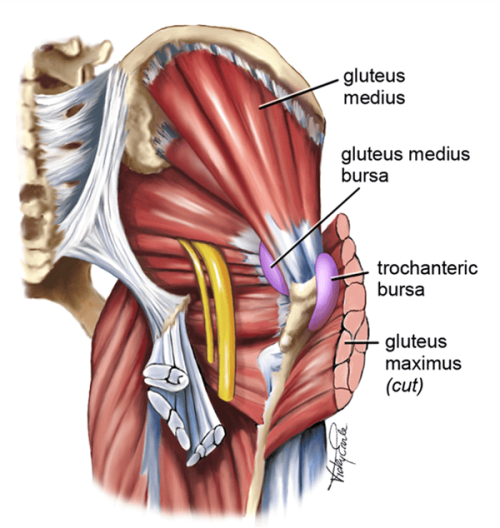
Relevant anatomy
Understanding some anatomy will help to understand how gluteal tendinopathy develops and how to treat it effectively.
- Greater Trochanter: This is a bony prominence on the outer aspect of the femur (thigh bone), just below the hip joint. It serves as the attachment point for the gluteus medius and minimus tendons.
- Gluteus Medius and Minimus Tendons: These tendons anchor two of the major hip-stabilising muscles to the greater trochanter. Their role is crucial in controlling hip and pelvic motion during walking and standing on one leg.
- Iliotibial Band (ITB): This thick band of connective tissue runs down the side of the thigh. Tension in the ITB can compress the structures under it, including the gluteal tendons and the trochanteric bursa.
It is important to note that this band is inextensible; it cannot be lengthened, stretched or ‘released’. - Pelvis and Neck of Femur Angle: The angle between the pelvis and the femoral neck influences how force is distributed through the hip. Anatomical variations here can predispose certain people to increased stress and compression onto the gluteal tendons.
A diagram from a patient leaflet published by the Royal Berkshire NHS Foundation Trust illustrates each of these elements.
What is Gluteal Tendinopathy?
Gluteal tendinopathy refers to pain that is often related to structural changes of the gluteus medius tendon, and sometimes the gluteus minimus tendon.
These tendons and their muscles are important for controlling your pelvis during standing, walking and running, which means that if they are painful it can be a real problem and quite disabling.
The tendinopathy is often accompanied by ‘bursitis’, which is fluid accumulation and thickening of the bursa that lies between these tendons and the iliotibial band.
The trochanteric bursa has historically been presumed to be the main problem, but it is now known to be secondary to the tendinopathy, not the primary source of pain.
A quick search of the internet for the condition will show many reputable sites still referring to this condition as hip bursitis or trochanteric bursitis. As always, check your information!
To help clarify the terminology, related terms for gluteal tendinopathy include:
- Greater Trochanteric Pain Syndrome (GTPS) – a broader term that encompasses gluteal tendinopathy along with other conditions like trochanteric bursitis
- Gluteus Medius/Minimus Tendinopathy – more specific terms highlighting the affected tendons
- Lateral Hip Pain – a general descriptive term used clinically, which includes gluteal tendinopathy among other possible causes
- Greater Trochanteric Bursitis – an outdated term, as research has shown that true bursitis is less common and rarely occurs in isolation
It’s important to recognise that while terms like “bursitis” and “GTPS” are often used, current understanding emphasises that tendinopathy is the primary problem rather than inflammation.
It is also important to know that having changes in your tendon on an ultrasound doesn’t automatically mean tendon pain.
Causes and risk factors for Greater Trochanteric Pain Syndrome
Just like all other tendon problems, the condition is primarily due to a failure of the tendon to adapt to load.
Like all tendinopathy, an important component of the development of gluteal tendinopathy is compressive tendon forces.
Compression of tendon tissue affects the tendon structure and reduces its tolerance to load.
There are many ways we inadvertently compress tendon tissue in daily life, such as with each step when walking. However, walking typically involves intermittent compression, with that force being taken off before being created again with each step.
The bigger problem are situations involving sustained compression.
Key contributors to greater trochanteric pain syndrome include:
- A sudden spike in activity levels (e.g. starting a walking or gym program)
- Prolonged positions that compress the tendon (e.g. sitting with crossed legs, sitting on low chairs)
- Biomechanical issues such as ‘poor’ gait patterns or ‘poor’ pelvic control
It is worth noting that holding a child on your ‘hip’ often involves standing with most weight on one leg and the hip pushed out to one side, causing significant compression of the ITB over the greater trochanter.
Got Questions? Speak to a Physio FREE
Book a 15-minute phone call with a local Adelaide physio – no strings attached.
Call 8356 1000 to organise a FREE ‘ASK A PHYSIO’ PHONE CALL today!
Who is at risk?
Gluteal tendinopathy is more common in women, particularly those aged 40 and older. Other risk factors include:
- Sedentary lifestyle or sudden increase in activity
- Weakness or lack of endurance in the gluteal muscles
- Biomechanical issues such as foot function or lack of pelvic control
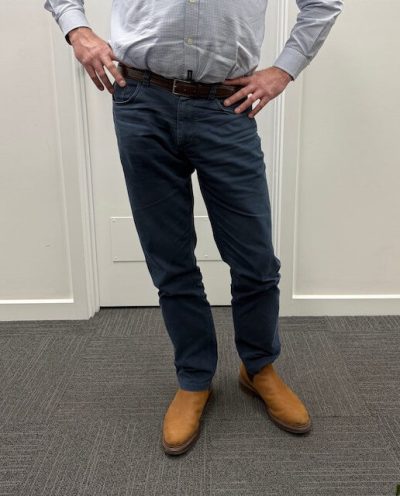
- Some postural habits, like standing with the weight on one leg, with pelvis thrust to the side
- Lack of adequate strengthening following total hip replacement
Why women aged 40 to 60 are particularly affected
This age group is disproportionately affected due to a combination of hormonal, anatomical, and lifestyle factors:
- Hormonal changes during perimenopause and menopause influence collagen production and tendon elasticity, making tendons more prone to injury
- A wider pelvis and altered hip biomechanics increase the angle of force through the hip, placing more strain on the gluteal tendons
- Decreased muscle mass and strength with age reduces load-bearing capacity through the hip
- Lifestyle shifts — such as from active to sedentary routines or vice versa — can result in abrupt changes in tendon loading.
Together, these factors create a perfect storm for the development of gluteal tendinopathy in this demographic. This is certainly the population that is represented the most in our clinic too.
Clinical presentation of gluteal tendinopathy
People with gluteal tendinopathy commonly report:
- Pain that is most acute over the lateral hip, possibly radiating down the outside of the thigh
- Pain worse at night, especially when lying on the affected side
- Difficulty with stairs, hills, prolonged standing or walking
- A tender point just above the greater trochanter
Pain may refer slightly behind the greater trochanter, and less commonly in front. It does not refer deep in the groin and rarely radiates below the knee.
Diagnosis
A physiotherapist or GP can often diagnose gluteal tendinopathy through a detailed history and physical examination.
Imaging (ultrasound or MRI) may be used to confirm the diagnosis or rule out other conditions but is not always necessary.
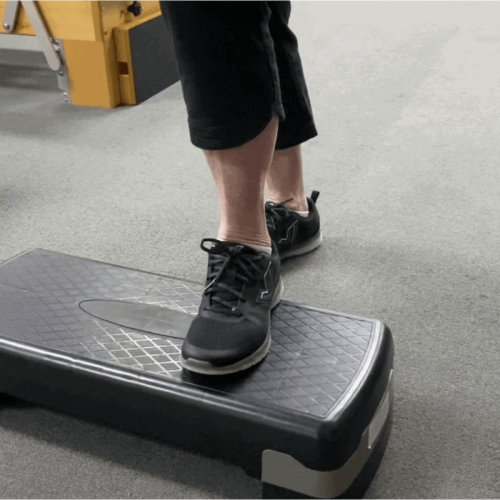
Clinical tests that reproduce your pain—such as palpation of the area, pain on strength testing, lying on your side, or standing on one leg—are often sufficient.
Not Sure if Physio Can Help? Ask Us First – Free Call
Chat with a qualified physio free and find out if we’re the right fit for your needs.
Call 8356 1000 to organise a FREE ‘ASK A PHYSIO’ PHONE CALL today!
How is it treated?
The good news is that gluteal tendinopathy responds well to non-surgical treatment, especially when caught early. Surgery is rarely required.
Management focuses on:
Education
- Understand the condition and how to modify activities to suit the load tolerance of the tendon
- Avoid positions that compress the tendon (e.g. crossing legs, low chairs, lying on the affected side without support)
- Sleep on the opposite side with a pillow between your knees to avoid the affected leg crossing over the top
- Limit walking on cambered surfaces or uphill if it worsens pain
Load Management
Reduce aggravating activities while gradually introducing exercises that help to build tendon load capacity.
Finding the ‘sweet spot’ with this is crucial – too little activity limits adaptation, too much causes flare-ups.
The process of finding the sweet spot can be tricky, and guidance helps.
Exercise Therapy
Progressive strengthening is a central pillar to improving the pain and reducing future episodes. A physiotherapist may recommend:
- Isometric hip abduction using a belt or strap to reduce pain and introduce gentle load
- Glute bridges, side-lying leg lifts, resistance band work
- Supported squats, progressing to functional single-leg exercises like step-ups or lunges
Correct form is essential to avoid excessive hip adduction.
Tendon adaptation does take commitment. It needs to a graduated program over many weeks with graduations that fit with the capabilities of the person and their painful tendon.
It also takes a level of understanding of the reason for the pain, and how to determine if the amount of pain is OK.
To effectively rehabilitate tendon tissue, some pain is necessary, but the key is knowing how much pain and how long it should last for after exercise.
Dry Needling
Dry needling can be effective to help people in the early stages of acute tendinopathy pain. It should be considered as a short term ‘gateway’ to the graduated loading that will improve the tendon capacity.
Corticosteroid injection can be useful for severe pain, but there is suggestion in the research that this is no more effective that dry needling (see the LEAP trial below).
That said, it makes you start to think about the mechanism of the injection and whether the steroid is the important element or not.

Can Gluteal Tendinopathy be prevented?
It would be optimistic to say you can prevent it, but you can certainly reduce your chances of getting it.
Preventative steps include:
- Regular hip and core strength training
- Avoiding sudden spikes in walking or running load
- Good posture and ergonomic sitting habits
- Supportive footwear
- Being wary of positions that cause excess compression in everyday life, like low chairs, crossing legs and ‘hanging’ on one hip
Summary
Gluteal tendinopathy and GTPS can be frustrating but are manageable with the right approach.
Active, not passive, management is key.
With targeted exercise and lifestyle adjustments, most people see significant improvement.
Even if pain subsides with a corticosteriod injection or dry needling, strengthening and loading the tendon tissue remains essential.
If you’re experiencing lateral hip pain or want to prevent tendinopathy, our experienced team is here to help.
We can help you not only improve your pain but to return to your usual activities feeling stronger and more resilient and lessen the chances of recurrence.
Contact us on 8356 1000 today to book an assessment and start your recovery journey.
Talk to a Physio FREE Today!*
Reach out now for a free phone consultation
Call us on 8356 1000 or click the button to book online *Valid for Adelaide residents only
Frequently-Asked Questions
What’s the best treatment for gluteal tendinopathy?
Education and exercise focused on load management and gluteal strengthening outperform corticosteroids and wait-and-see in both short- and long-term outcomes.
Can I stretch or massage it?
No—these can worsen symptoms. Tendons dislike compression; stretching or massage may aggravate the condition.
How long does recovery take?
With proper management, many improve in 8–12 weeks, but tendon healing may take months.
Long-term gains depend on adherence to exercises and lifestyle changes.
Is gluteal tendinopathy the same as bursitis?
No. While they can coexist, current evidence shows that lateral hip pain is usually due to tendinopathy, not isolated bursitis.
Bursal inflammation is often secondary to tendon dysfunction.
Can cortisone injections help?
Corticosteroid injections may provide short-term relief, but they are less effective long term and can be counterproductive if tendon tears are present.
The LEAP trial* published in 2018 showed better outcomes with exercise and education.
*Mellor R, Bennell K, Grimaldi A, Nicolson P, Kasza J, Hodges P et al. Education plus exercise versus corticosteroid injection use versus a wait and see approach on global outcome and pain from gluteal tendinopathy: prospective, single blinded, randomised clinical trial BMJ 2018; 361 :k1662 doi:10.1136/bmj.k1662