GLAD programme

GLA:D Osteoarthritis Programme

GLA:D is provided by GLAD trained physios at Adelaide West Physio + Pilates to help knee and hip osteoarthritis

Do any of these sound like you?

  • Have you been told that you have knee or hip osteoarthritis?
  • Has your GP or surgeon told you that arthritis is likely to happen in the future?
  • Have you been told that you are going to need a joint replacement, and thinking that surgery is your next step?
  • Would prefer not to go under the surgeon’s knife quite yet?
  • Have you ever wondered if there are any other effective treatments apart from taking more medication
  • Are you reliant on your anti inflammatory medication to function?

Would you like LESS PAIN, LESS MEDICATION, MORE ACTIVITY and BETTER QUALITY OF LIFE?

If any of this describes you, keep reading!

Quick links

The problem with current OA treatment
What is GLA:D?
What can GLA:D do for me?
• Are you thinking ‘it’s not for me’?
Why is it called GLA:D?
Are you saying that I won’t need a joint replacement?
What does the programme consist of?
• What is the cost?
Frequently Asked Questions

The problem with current OA treatment

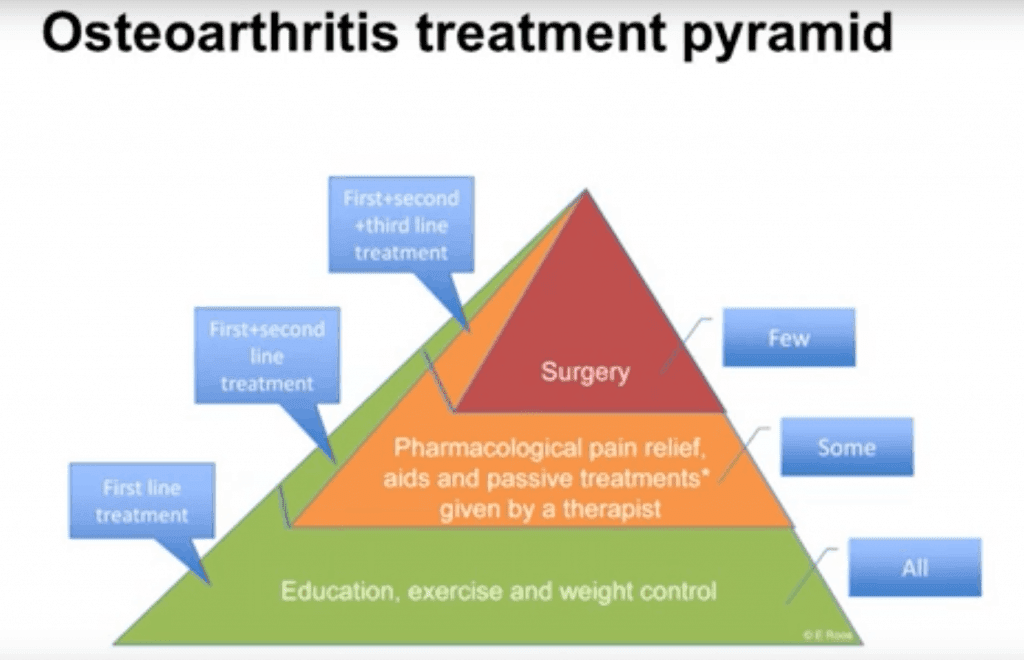
It may surprise you to know that (despite advertising) the first treatment option according to the medical guidelines ISN’T medication. It certainly isn’t joint replacement surgery!

Best of all, the recommended first line treatment for osteoarthritis are DRUG-FREE and SURGERY-FREE.

The problem is that these treatment guidelines often aren’t followed. We know that it is much easier to use medication to reduce pain temporarily than to find somewhere that is going to offer trustworthy, effective and research-backed treatment options. 

This is where the GLA:D programme comes in.

GLA:D Osteoarthritis treatment pyramid that shows the importance of the GLAD programme
This is the osteoarthritis treatment guidelines – EVERYONE should do the first line treatments at the bottom of the pyramid!

What is GLA:D?

GLA:D is a structured programme of exercise and education provided by physios specially trained in delivering the programme. The GLA:D programme follows the best available evidence for first line treatment of knee and hip osteoarthritis.

It was created in Denmark in 2014 in response to physios realising that the first line treatment options in the medical guidelines were often skipped. Medication was being prescribed or joint replacement surgery performed without a sufficient trial of the well-researched treatment options of exercise, weight loss, and education about managing their joint. You can see a video about how GLA:D began on one of our previous blogs here.

There are more than 50 randomised controlled trials that show exercise is effective.

The caveat is that it needs to be the right kind of exercise for the individual and the right dose that is progressed correctly.

What can GLA:D do for me?

Part of the GLA:D programme was creating a database of the results from the beginning, which helps measure its effectiveness, and build up the evidence base for the programme.

This is how we can say that the results from the GLA:D programme so far shows symptom reduction of 32%!

This is a really impressive figure, and even better when you combine it with the other outcomes including:

  • reduced use of joint related pain killers 
  • less people on sick leave and
  • increased levels of physical activity 12 months after starting the programme

These results are impressive by anyone’s standards. In addition, it doesn’t include any of the risks associated with medication or surgery.

The results of a well constructed programme of exercise, advice and weight loss are simply too good to ignore.

DON’T SKIP THE FIRST RECOMMENDED LINE OF ATTACK!

Are you thinking ‘it’s not for me’?

‘I don’t need a class! I can exercise on my own.’

That may well be true, you can exercise on your own. Bear in mind, in order for the exercise to be effective, you must know:

  • what the best forms of exercise are for you
  • which ones that you need to avoid, and
  • the correct dosage for you.

Each of these is going to  vary depending on your situation, your abilities and your pain.

By the end of the GLA:D programme, you will be able to answer each of these questions and you will have a programme that works so that you can continue exercising on your own.

The main problems that we see clinically are:

  • patients being told to ‘go and exercise’ but not knowing what to do
  • patients exercising but not doing the right types of exercise that either don’t help reach their goal, or make them worse, then concluding exercise doesn’t work
  • not doing enough exercise to have an effect, then concluding that it doesn’t work
  • doing too much and overloading the joint and increasing pain, then concluding it doesn’t work
  • lacking the motivation and accountability to exercise consistently
  • patients exercising under the guidance of someone else who doesn’t appreciate osteoarthritis, and the patient’s abilities or limits, then concluding it doesn’t work

Why is it called GLA:D?

(‘Cos I’m really not glad that I have this pain!)

GLA:D is an acronym for ‘Good Life With (osteo) Arthritis in Denmark’ – its country of origin.

Are you saying that I won’t need a joint replacement?

We are certainly not saying that no one will need joint replacements! There are good reasons to have a new joint and the benefits can be huge. However, the literature is clear that it shouldn’t be the first or second option for treatment of OA of the hip or knee.

Some of the people that go through the GLA:D programme are able to avoid joint replacement, and some are able to delay it significantly. Importantly, those that do go on to have a new joint are going to do so with MUCH BETTER PREPARATION!

The physios trained in GLA:D also have an in depth knowledge of the current literature on the different interventions that are available, so that you can have a well-informed discussion about your different treatment options including joint replacement, injections and more.

What does the programme consist of?

  • Initial consultation with a GLA:D trained physio
  • 2 x 60 minute exercise sessions per week for a 6 week period
  • 2 x education sessions 60 minutes
  • Goodie bag
  • A review session after the 6 week period.

You are required to attend an initial consultation, where the first job is to determine if the programme is suitable for you and if it will be effective for you. The next task is to work out your capabilities so that your programme will be suitable for you – not too much and not too little. In that session, we will be getting some measures of where you are right now so that we can measure the change over the six week period.

Once we book in the sessions we will give you a start date and end date of your program, and all your appointments will be made in advance, including the education sessions.

It is a six week programme of two group sessions per week. This is the minimum length of time that research has found to produce the results that you are looking for. In addition, you are encouraged to do home exercises to complement what you are doing in the sessions.

The two education sessions that our physios run are to fill you in on the latest in managing your joints and how to work out how to work with any exercise-related pain. These are really important sessions, full of useful information.

You also get a goodie bag when you join which contains:

  • a drink bottle
  • the theraband that you need for your home exercises
  • a slider for home exercises that you will use in your sessions
  • a voucher for a half price massage with our Remedial Massage Therapist as a treat!

What is the cost?

If you are accepted into the programme after the initial consultation, the cost is an all-inclusive package which includes all groups, education sessions and review.

The price is heavily discounted compared to charging for each session individually.

You have a choice between an upfront payment, or weekly installments using a direct debit facility.

Contact us on 1300 730 574 or email us on admin@adelaidewestphysio.com.au for the up-to-date pricing.

You can also contact us via Facebook messenger at m.me/AdelaideWestPhysio.

NOT SURE IF GLA:D IS FOR YOU?

Wondering if you are ‘too far gone’?

Or ‘not bad enough’ to consider GLA:D?

Ring us on 1300 730 574 and organise a time to chat with one of our GLA:D-trained physios, or message us on Facebook at m.me/AdelaideWestPhysio

Frequently Asked Questions

Can I claim these sessions under my Private Health Insurance?
If you have extras cover, you should be able to claim these sessions. The best way to check is to quote the item numbers to your insurer and they can confirm whether they will.

What are the item numbers?
The initial consultation – 500; any subsequent sessions including the 6 week review session – 505; the groups – 560.

Does it have to be 6 weeks? Does it have to be 2 sessions per week?
The researchers of the GLA:D programme have found that two sessions per week over 6 week period is the best for seeing the best results.

I am going away in the middle of the programme – does that matter?
It might be best to start after you return, otherwise you will be missing sessions – you will be paying for sessions that you won’t be attending, and not getting the results that you would otherwise be expecting.

What if I am sick during the six week programme, or miss a session?
If you are sick or miss a session for any other reason, you can reschedule that session within the same week if there is an available spot in a GLA:D group.
You may be able to squeeze in three sessions the following week but that only be if your physio felt that it would be suitable for you.
If you are unable to reschedule your missed session, you should try your best to complete your exercises at home using the equipment & program we have given you.

I can’t come through the day, can I do it after hours?
Although the dedicated GLA:D programme is run through the day, we do have GLA:D instructors running Physio Group Treatment after hours, which means we can accomodate after hours too. It still needs to be 2 sessions per week for 6 weeks.

I’m having a Total Knee Replacement / Total Hip Replacement. Is it worth doing the programme?
Absolutely! Even though our aim is to prevent the need or delay the need for joint replacements, the GLA:D programme is also the ideal pre-operative programme for joint replacement too. It will allow you to be as strong and able as possible going into surgery, so that your recovery is quicker and more complete after surgery.

What if I’m not accepted into the GLA:D programme?
This can be for a number of reasons. It may be due to an inability to commit to the number of sessions, or for a health reason. Whatever the case, your physio will come up with an alternative plan to make sure that you get the best outcome possible within your constraints.

Can I use an EPC?
You can use the EPC from your GP towards the initial consultation and the followup consultation, but it cannot be used towards group sessions.

Can I do the GLA:D programme if am covered by DVA?
You would need to have a referral from your GP as per the

Is the GLA:D programme run by physios?
Under the GLA:D policies, it can only be run by qualified physios who have done the GLA:D training. This is why you can claim these sessions under your Private Health Insurance.

How many people are in a group?
We hold a maximum of 6 people in the group, though this has been reduced to 5 in the light of the current COVID-19 situation to allow even more room in the gym.

What are the times of the groups?
It is best to check that with Jacqui or Brooke at the front desk, but they are scheduled for the late morning on Monday and Thursday currently. The sessions are an hour long.

Are there different payment options to make is easier to afford?
Yes. Even though the sessions are heavily discounted as a package, we understand that paying the whole amount up front isn’t possible for some people, but we don’t want to exclude people that really need the help.

Apart from a one-off up front amount, we can also accept weekly payments using direct debit that is administered internally. It means that we can be agile with any changes that need to be made.

Speak with Jacqui or Brooke for more information about these options.

What type of exercises are done in the sessions?
The exercises are adjusted to your individual capabilities, however your joint pain is affecting you or whatever your current strength happens to be.

What do the education sessions consist of?
There is some core information that is required to be delivered in the GLA:D programme, but we spice it up a bit with some new research and keep it as interactive as it can be.

The information is to help you understand your osteoarthritis a bit differently in line with the current research. It will help you to understand that it isn’t just wear and tear, that you shouldn’t necessarily rely on your pain as your guide about how much to do, and that using your joint and strengthening your muscles have very real positive effects on osteoarthritis.

The education sessions will set you up for the exercise that you do during the programme so that you understand why you are doing what you are doing.

When can I get started?
As we have limited numbers at any one time, it just depends on when a vacancy comes up in the programme. If you are interested in the GLA:D programme, if you speak with our front desk team, we may be able to hold a spot for you in an upcoming intake.

In the meantime, it might help to speak with a physio if you have any queries about the programme.